

He Had Never Seen an Arrest Run Like That
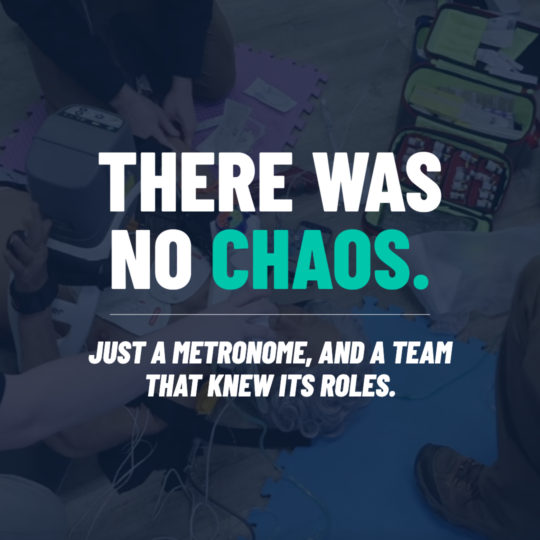
The police officer had worked plenty of cardiac arrests before, in other towns. But after his first one in Westford, Massachusetts, he said something that stopped the crew in its tracks:
“I’ve never seen an arrest run like that.”
What had he seen? There were no extraordinary new medications, no experimental equipment, and no secret intervention. What struck him most was something that wasn’t happening.
There was no chaos.
The room was quiet except for a metronome. As many as six paramedics were at the patient’s side, yet only two were performing advanced interventions. Everyone else seemed to know exactly where to be and what to do. No one was asking what came next. No one was waiting for instructions. In one of the most stressful moments imaginable, the team looked almost choreographed.
That raises a much bigger question: What separates an EMS agency that follows the same resuscitation guidelines as everyone else from one that consistently turns those guidelines into better outcomes?
The Numbers Tell a Sobering Story
The 2025 CARES Annual Report offers a place to start.
Among 163 EMS agencies that each treated at least 200 cardiac arrests in 2025, survival to hospital discharge ranged from 1% to 19.7%. The national average was 10.5%.
That is nearly a 20-fold difference.
These aren’t tiny departments with too few cases to measure. These are agencies treating hundreds of patients, working from the same fundamental resuscitation science, yet producing dramatically different outcomes.
Survival depends on many factors: patient characteristics, bystander CPR, response times, hospital care, and more. These numbers don’t prove that any one approach explains the differences. But they force us to confront an uncomfortable question:
If the science is largely the same, why aren’t the outcomes more alike?
Our industry has a familiar response. We revise protocols. Add medications. Change algorithms. Introduce new equipment. Sometimes those changes are necessary.
But what if the biggest opportunity isn’t changing what we ask clinicians to do? What if it’s changing how reliably they do it?
A Closer Look at Westford
Bill Olsen, Westford Fire Department’s clinical coordinator, recently walked our team through how his crews approach cardiac arrest.
Over a recent 10-month period, Westford’s crews worked 21 arrests. Five patients survived to hospital discharge neurologically intact. That’s nearly 24%.
Twenty-one cases are far too few to establish that any system is superior. But five people surviving neurologically intact is worth examining.
And Westford may not be an isolated example.
- Palm Beach Gardens Fire Rescue (Florida): In 2025, we achieved 23% survival to hospital discharge with favorable neurologic function, according to CARES data. We had made a series of changes to our approach to cardiac arrest, including intensive team training, resuscitation practices, and clinical protocols. Our analysis found that favorable neurological survival increased substantially after implementation of a multidomain care bundle. The study can’t tell us which individual changes made the difference, and it can’t prove the bundle alone caused the improvement. But it reinforces an important question: what happens when an EMS system examines the entire resuscitation process rather than just the protocol?
- South Metro Fire Rescue (Denver metro area): South Metro reported neurologically intact survival of 14.4% in 2023, up from 7.8% the year before, and well above the national benchmark shown in its data.
Three agencies. Different communities. Different teams. Their experiences don’t establish a single formula for success, but they raise a question worth asking: What are high-performing EMS systems doing differently, and how can the rest of us learn from them?
The most interesting part of these stories isn’t a single resuscitation. It’s what happens before the next one.
The Work Before the Emergency
Bill and his team have embraced an approach we teach at Handtevy: clear leadership, defined roles, and repeated practice until the entire team moves as one.
The day Bill spoke with our team, one shift had just completed three hours of pit crew drills. Another shift had done the same the day before. Three hours, one shift after another.
This isn’t an annual skills check or a quick refresher before a certification expires. It’s deliberate repetition, designed to make the right actions feel familiar before the pressure becomes overwhelming.
Monongalia EMS, under the leadership of Robby May, offers another powerful example. Their high-performance CPR training shows what happens when teams repeatedly practice the fundamentals until disciplined, coordinated resuscitation becomes second nature.
Watch: Monongalia EMS high-performance CPR training in action
Technology supports the approach, but the real work is building a team that can perform together when there’s no time to figure things out.
At Westford’s station, a wall celebrates patients who achieved return of spontaneous circulation in the field and were discharged alive from the hospital. Some displays include the actual rhythm strip from the shock. Each one represents a person who made it home, and each one reminds the crew what all those hours of practice are for.
What the Officer Saw
That is what the training is for. Not the drills themselves. Not the numbers on a report. Not even the satisfaction of watching a team perform smoothly under pressure.
It’s for the person on the floor, and for the family waiting to find out whether that person is coming home.
Every arrest gives a crew one chance to get it right. The outcome will never be completely within its control. But preparation can determine whether the team brings order to the moment or becomes part of the chaos.
In Westford, one officer saw the difference. He saw what happens when a team practices until the right actions become automatic, when every person knows the role they’re expected to play, and when calm isn’t a matter of personality but the product of preparation.
The next time the call comes in, the crew won’t know whose family is waiting on the other side of it. But they’ll be ready to give that family the one thing that matters most: more time together.
Let’s Talk About Your Outcomes
If you’re an EMS leader, I’d welcome a conversation about what your own outcomes are telling you and what other agencies’ experiences might teach us. We have much to learn from one another about training, teamwork, and turning evidence into consistent performance. [Contact the Handtevy team]
This article was originally published on LinkedIn.
About the Author

Peter Antevy, MD, FAEMS is a board-certified pediatric emergency medicine physician, EMS medical director, and the Founder and Chief Medical Officer of
Handtevy. He has spent his career focused on improving emergency care for both adults and children, with a particular emphasis on medication safety, resuscitation, and closing the gap between evidence-based medicine and what happens in the field and at the bedside.
Dr. Antevy serves as an EMS medical director in South Florida, where he oversees some of the busiest prehospital systems in the country. He is a nationally recognized speaker, researcher, and educator in emergency medicine, and has been instrumental in advancing pediatric readiness across EMS and hospital systems nationwide.
Through Handtevy, Dr. Antevy and his team support close to 200,000 EMS and hospital customers across all 50 states with purpose-built clinical decision support tools designed to reduce medication errors and improve outcomes during the most critical moments in patient care.
DISCLAIMER: These links are provided for research and do not have affiliations with Handtevy.